MetaPost and TikZ,
with real LaTeX
MetaPost 2.11, pdfTeX 1.40, LuaTeX 1.21 and dvisvgm 3.4 from TeX Live 2025, compiled to WebAssembly and wrapped in one small TypeScript library. MetaPost source goes in and SVG with real glyph outlines comes out; so do whole LaTeX documents, with TikZ, pgfplots and tikz-cd, one SVG per page. It runs in a web page, in a Web Worker or in Node. Nothing runs on a server.
The output is byte-identical to native TeX Live: the same C code produces it, and every deviation from upstream is a numbered, explained patch. The complete 1181-page PGF/TikZ manual typesets through the library page for page identical to latex + dvisvgm.
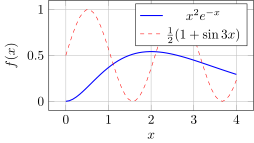
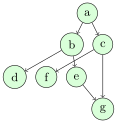


What it does
Not a reimplementation of either language, but the real programs.
The engines are the programs from TeX Live 2025, compiled to WebAssembly, so anything that typesets on a TeX installation typesets here, and the output is the same to the byte.
All of MetaPost
Every number system, boxes.mp and graph.mp, and btex … etex labels typeset by plain TeX or LaTeX — collected into a single TeX run and cached by content. Out comes SVG, the EPS mpost writes, or a JSON model of the figure.
Whole LaTeX documents
\documentclass, \usepackage, every PGF/TikZ library in TeX Live, pgfplots, tikz-cd, amsmath and Latin Modern. Shadings become gradients, patterns stay patterns, and opacity and clipping survive.
LuaTeX when it's needed
Graph drawing, \directlua and luacode switch to a second engine, LuaTeX, which is downloaded only when a document asks for it — and brings OpenType fonts with it.
A tikzjax replacement
One script tag finds <script type="text/tikz">, text/metapost, <tikz-diagram> and <metapost-diagram> elements, renders each in place, and keeps the results in IndexedDB for the next visit.
Fetched as it's needed
Fonts, macros and formats are plain static files, fetched through the real kpathsea as the engines ask for them: about 4.7 MB for a first TikZ figure, 2.3 MB for a first MetaPost one, then the browser cache.
A command line too
mpost-wasm accepts mpost's options and writes mpost's output files, takes --latex for documents, and --prerender saves a page's figures beside it, sparing first visits the engines.
Using it
On a web page, a single script tag is enough. Diagrams are written straight into the HTML, and each is replaced by its SVG:
<script type="module" src="/path/to/dist/auto.js"></script>

<script type="text/tikz" data-libraries="arrows.meta">
  \begin{tikzpicture} \draw[->,thick] (0,0) -- (2,1) node[right] {$x^2$}; \end{tikzpicture}
</script>
<script type="text/metapost">draw fullcircle scaled 50; label.top(btex $\int_0^1 x\,dx$ etex, (0,25));</script>
From JavaScript, the API returns the figures and pages directly:
import { MetaPost } from './dist/index.js';
const mp  = await MetaPost.create();
const fig = await mp.run('beginfig(1); draw fullcircle scaled 100; endfig; end.');
const doc = await mp.latex(String.raw`\documentclass[tikz]{standalone}
  \begin{document}\tikz\shade[ball color=blue!60] (0,0) circle (1);\end{document}`);
document.body.innerHTML = fig.figures[0].svg + doc.pages[0];
The feature guide covers every option, rendered by the engines themselves — among its examples a paragraph set inside a circle by TeX's \parshape, with inline TikZ pictures and displayed mathematics, which is the kind of thing a real TeX can do and a picture-only engine cannot.
Demos
Everything on these pages is rendered in your browser by the WebAssembly engines.
Feature guide
The complete documentation, with every feature rendered by the engines: installation, the drop-in tags, the API, the command line, how it works, fidelity and limits.
OpenEditor demo
Galleries of MetaPost and TikZ examples with a live editor.
OpenDrop-in tags
A page whose diagrams are just <script type="text/tikz"> elements.
Real-time graphics
Six animations and interactive plots regenerated by MetaPost and LaTeX as you move the controls.
OpenTwo editors
A MetaPost editor and a TikZ editor side by side with their output.
OpenSingle-file playground
The same in one 11 MB file with everything inlined, for saving and using offline.
OpenGet it
The prebuilt release is what most people want. Download mp-tikz-wasm-0.5.0.tar.gz or .zip from the releases page and unpack it: it holds the compiled engines, the JavaScript, the bundles and these demo pages, and needs neither TeX Live nor Emscripten.
tar xzf mp-tikz-wasm-0.5.0.tar.gz && cd mp-tikz-wasm-0.5.0
node serve.mjs 8080        # then open http://localhost:8080/site/
Host the dist/ folder on any static server — plain files, no special headers — and add the one script line to your page, or import dist/index.js. Building from source, with the twelve upstream patches each explained, is described in the repository.
Licences
mp-tikz-wasm's own code is under the LGPL-3.0. Each upstream program it builds keeps its own licence — the TeX engines and dvisvgm are distributed under the GPL — and NOTICE.md sets out what applies to what.